How AI music videos are made: likeness, lip-sync and a world that holds together
An AI music video is directed as a music video first and an AI production second. This is how U3 holds an artist's likeness, voice and performance for the length of a song, and what it has released.
By Mohamed Yousry, founder · Published · 5 min read
How AI music videos are made: the short answer
An AI music video is made by locking the artist's likeness before any scene is built, lip-syncing the performance to the vocal line by line, designing every scene around what the lyric is doing, and editing on the song rather than on whatever the tools happened to produce. At U3 each video is then graded as one film and cut into the formats the artist publishes in.
A music video is the hardest test of AI consistency: the artist must look like themselves in every cut, the mouth must match every syllable, and the world must hold together for three or four minutes. A short concept clip is easy to dismiss; a full song is not. The service is described on the AI music videos page.
Step one: lock the likeness and build the world
Before a single scene is made, the artist's likeness is locked as a character reference and held in every scene of the video. With two performers, both are locked, and wardrobe and location systems keep what they wear and where they are consistent from the first shot to the last.
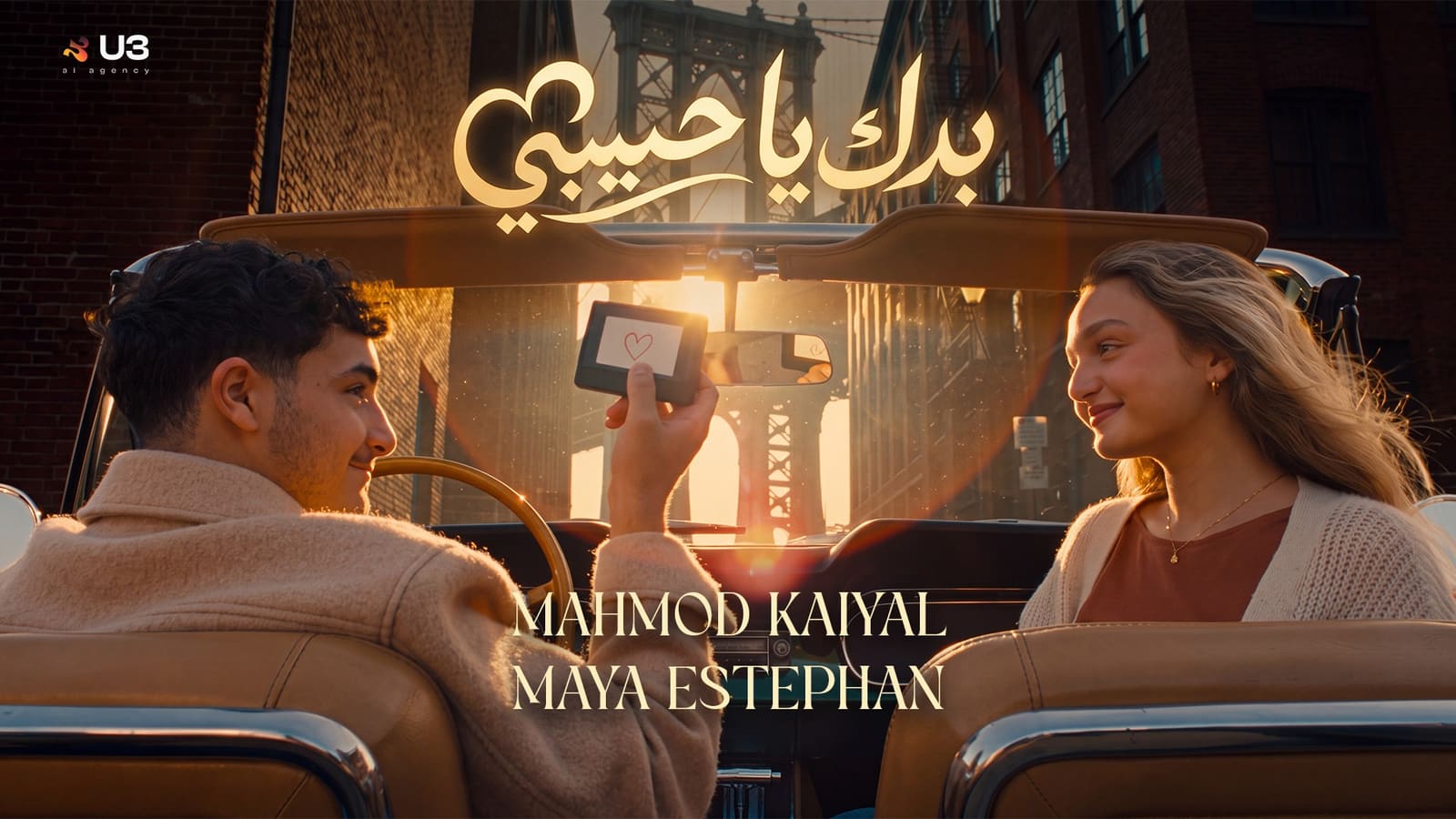
The world is built the same way. For Baddak Ya Habibi, a duet for Mahmoud Kayal and Maya Estephan set in New York, U3 built the city as production worlds, the streets, the bridge and the car, instead of taking a production there, and art-directed each world to the song.
Step two: performance and lip-sync
The performance is lip-synced to the final vocal, line by line, so the mouth carries the song rather than approximating it. Where the story needs two people, the performance and lip-sync sequences are directed as two-artist storytelling and then edited as one film.
In “Matemsheesh”, one of two U3 originals later shared by Tamer Hosny, the character lock covered his co-star Hana El Zahed as well, and held across every scene of the video.
Step three: edit, grade and release versions
The edit is cut on the song: scenes are designed to the lyric and then edited to the final vocal. Each video is graded as one film, so the scenes read as one world rather than a sequence of generated shots.
Delivery follows the channels the artist releases on. The two visuals shared by Tamer Hosny were cut and conformed for Instagram, Facebook, TikTok and YouTube. Baddak Ya Habibi shipped as the full 3:04 music video with cover assets and vertical and wide versions.
What U3 has released
Baddak Ya Habibi is a full 3:04 music video for Mahmoud Kayal and Maya Estephan, released on YouTube. It was completed in about two weeks with no international location shoot, at roughly a fifth of a conventional international location-shoot benchmark for that project, a figure confirmed by U3. U3 has made two more music videos for Mahmoud Kayal, among them Ya Salam.
From Tamer Hosny's 2026 album “Mesh Hatkarar”, U3 made AI visuals for two tracks as U3 originals: “Met'asar Beghyabo” and “Matemsheesh”, with Hana El Zahed. Both were subsequently published on the artist's own channels, and each passed 3 million views there as of September 2026, as confirmed by U3. Tamer Hosny is not a U3 client; the case study links to his own posts.
Fan-made work is labelled as fan-made
U3 also makes work on its own initiative, and says so. “Kifak Inta” is an unofficial, fan-made AI tribute that imagines Fairuz's song as a duet with Tamer Hosny. It was made without a commission, was not released by the artists and has no affiliation with Fairuz, Ziad Rahbani or Tamer Hosny. Its end card credits the song to Fairuz and Ziad Rahbani, and the film's page carries the same label.
On U3's site, public-figure work says which of three things it is: commissioned by the artist or their team; a U3 original, as the two album visuals above were, made by U3 first and shared by the artist afterwards; or a fan-made tribute, labelled unofficial. In a video an artist commissions, the artist's likeness and voice are used with documented consent, as U3's rights and AI policy sets out.
How to brief an AI music video
Send the track and a reference or two on the music video brief: which song, which artist, the mood you hear and the release date. U3 comes back with a treatment, a runtime and a price per finished minute. Production moves through approved stages, and key-frames come to you as stills with a revision round before animation starts.
Production is paid 50% to start and 50% on delivery, and the usage terms are written into the statement of work. For more on what moves a budget, read what an AI video ad costs.
Questions buyers ask
Can an AI music video lip-sync to the singer's real vocal?
Yes. The performance is lip-synced to the final vocal line by line, and the artist's likeness is locked so they look like themselves in every cut.
How long does an AI music video take?
It depends on the length and complexity, and the timeline is agreed at the brief. Baddak Ya Habibi, a 3:04 video for two artists, was completed in about two weeks.
How is an AI music video priced?
Send the track and a reference or two; U3 replies with a treatment, a runtime and a price per finished minute. Productions are paid 50% to start and 50% on delivery.
How are the Tamer Hosny visuals credited?
As U3 originals, made independently and subsequently published by Tamer Hosny on his own channels. Tamer Hosny is not a U3 client.
Does U3 make fan-made music videos?
Sometimes, on its own initiative, and always labelled: “Kifak Inta” is an unofficial, fan-made tribute and is never presented as an official release.
Related work
- “Baddak Ya Habibi” AI Music Video, Full Length — Case study
- AI Music Visuals Shared by Tamer Hosny — Case study
- Ya Salam — Mahmoud Kayal — Film
- “Kifak Inta” — an unofficial AI tribute to Fairuz — Film
Services
More insights
- AI feature films: what is possible today, and how one is made — A feature film can now be built entirely with AI, as long as the faces, the worlds and the grade hold for ninety minutes. This is what the work involves, how U3 runs it stage by stage, and the shorter films it has already made.
- Planning Ramadan 2027 with AI: series, channel content and ads — Ramadan 2027 is a fixed deadline, and everything made for it has to be ready before the month begins. U3 is now open for Ramadan 2027 collaborations with production companies, channels and brands; here is how to plan the work with AI.
- AI dubbing for companies: one film in every language your teams work in — AI dubbing lets a company produce one film and deliver it in each language its people work in, every version lip-synced. Here is how U3 does it, with a published safety film as the example.