How an AI video production runs: five approved stages, from brief to delivery
Every U3 production moves through five stages, and none starts until you approve the one before it. Here is what happens at each stage, what you sign off, and how payment, ownership and refunds work.
By Mohamed Yousry, founder · Published · 5 min read
How an AI video production runs at U3
An AI video production at U3 runs on five approved stages: brief and direction, voice-over, scenes and key-frames, cinematic animation and sound, and delivery. Each stage is approved before the next one begins, so you always know where your film stands and nothing arrives as a surprise at the end. You approve the still frames before anything moves.
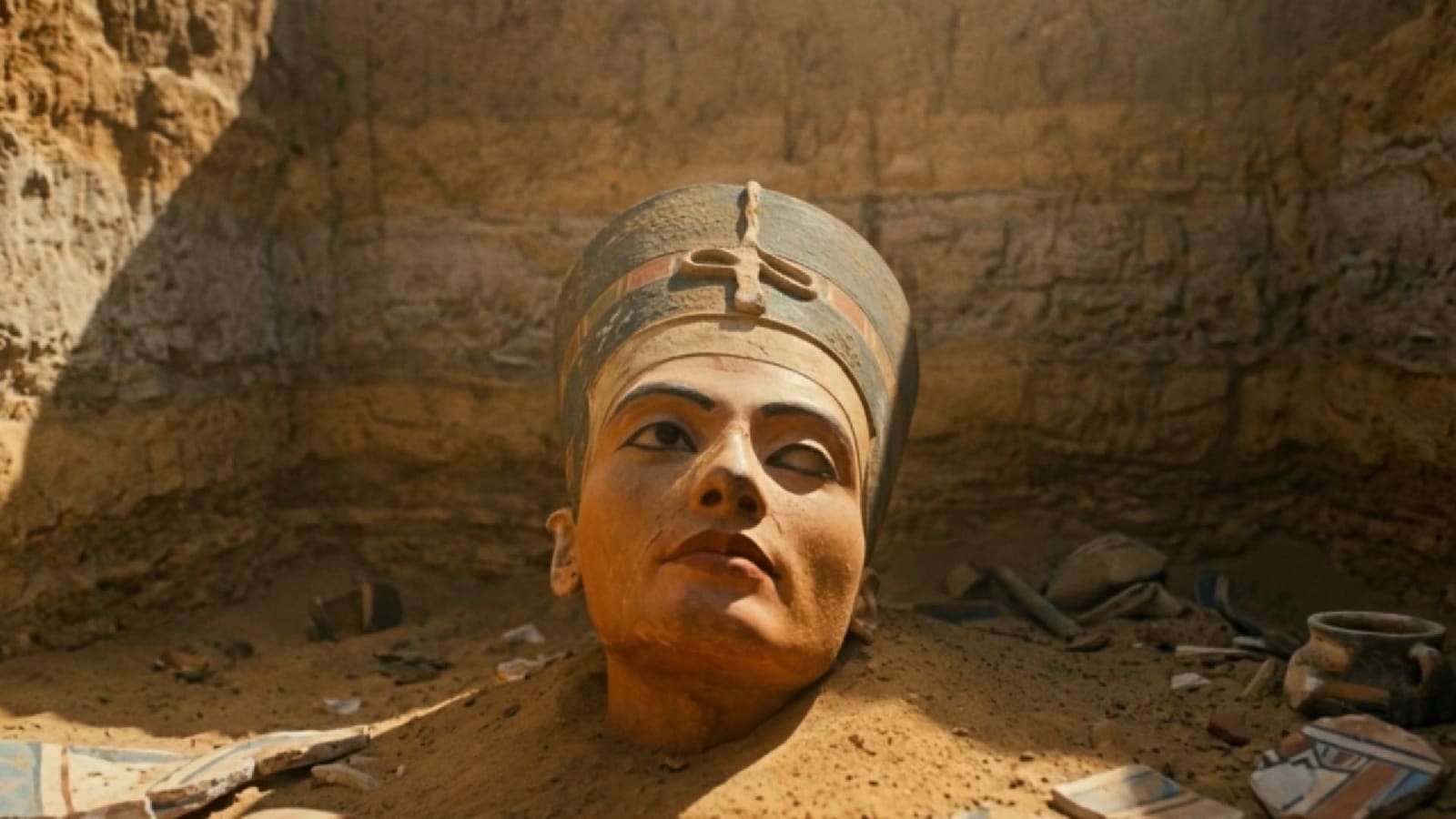
The same stages sit behind every production, from a widescreen historical film such as Nefertiti, made for Mr. Mohamed El-Sayed, to a safety film for an industrial group. Post-production is not a department the film is handed to at the end; it is the fourth and fifth stage of the same pipeline, run by the same team. Production is delivered remotely from Alexandria, and each stage is approved online, in your time zone.
Stage one: brief and direction
We align on the idea, the tone and the spec. A brief can be a call, a document or a voice note. What helps most is a clear brief, your brand assets, such as the logo and product shots, and any references you love: the clearer the input, the closer the first cut lands to the picture in your head.
Briefs come in through the project form in three short steps, and you receive a reference straight away. The team reads every brief and comes back with questions or the next step. If there is a fit, there is a call, then a scoped proposal with its schedule. There is no public rate card and no fixed package.
Stage two: the voice-over is approved first
The voice is approved before any scene is made, because it sets the rhythm of everything that follows. Voice-over is produced in Egyptian, Gulf or Modern Standard Arabic, English or German, and the voice, the lip-sync and the on-screen text are matched to the market the film is for.
On the safety film U3 made for thyssenkrupp Uhde, each scene was designed around a single line of voice-over, so the picture never competes with the message. The case study shows the result in full.
Stage three: scenes and key-frames, approved as stills
Before anything is animated, the key-frames come to you as still frames for review, with one revision round on us. This is where characters, products, places and the look are locked. U3 builds locked character identities that stay consistent across scenes, films and whole campaigns, so a brand character looks the same in film one and film twenty.
For First Step, an autism care centre in Kuwait, approved references were used to build one controlled world of characters and spaces, which was then reused across recurring awareness films. Each new film became a script decision rather than a new production. The First Step case study explains how.
Changing a still is quick; changing a moving shot is not. That is why big changes after animation has started restart the stage, and why the stills are the right moment for your notes.
Stage four: cinematic animation and sound
The approved frames come alive: motion, music and sound design. U3's in-house post team edits the film and adds motion graphics, 3D, VFX and compositing where the film needs them, then grades the colour and mixes the sound. The disciplines are described on the post-production page.
Revisions at this stage are handled inside the production cycle. On the thyssenkrupp Uhde film there was no reshoot and no second site visit.
Stage five: delivery, and what you own
The final cut is colour-graded and mastered, ready to run anywhere, and delivered as files to your drive: masters, language versions, captions and cutdowns, as the project requires.
You own the film for the commercial use agreed in the project, whether that is paid media, broadcast, digital or internal use. Usage and ownership terms are written into the statement of work and transfer with the final payment, subject to the licences of any third-party assets or tools used in production. Nothing U3 makes for a client appears on its website, reels or social channels unless the client approves it in writing.
Timeline, payment and refunds
Timing depends on duration and complexity. The timeline is agreed at the brief stage and then kept, and a focused ad lands in days, not months. If your deadline is tight, say so up front and you get an honest answer on whether it is possible.
Productions are paid 50% to start and 50% on delivery, with no hidden fees. Refunds follow the stages: before work begins, the deposit is fully refundable; up to the voice-over stage, U3 refunds the value of the work not yet done; once animation and montage start, the production is committed and there is no refund; and there is none after the final cut is approved and delivered. The refund policy has the full terms, and what an AI video ad costs explains how a budget is built.
Questions buyers ask
How many revision rounds are included?
Key-frames come to you as stills with one revision round on us before any animation starts. Big changes after animation has started restart the stage, which is why each stage is approved before the next begins.
Why is the voice-over approved before the scenes?
Because it sets the rhythm of everything after it. Scenes are built to the approved voice, so the picture and the message stay in step.
When do I own the finished film?
Usage and ownership terms are written into the statement of work and transfer with the final payment, subject to the licences of any third-party assets or tools used in production.
Can I cancel after the project has started?
Before work begins, the 50% deposit is fully refundable. Up to the voice-over stage, U3 refunds the value of the work not yet done. Once animation starts, the production is committed.
How long does an AI video production take?
It depends on duration and complexity. The timeline is agreed at the brief stage and kept, and a focused ad lands in days, not months.
Related work
- thyssenkrupp Uhde AI Safety Film in 3 Languages — Case study
- First Step Kuwait: Pediatric Health Content, No Kids Filmed — Case study
- Nefertiti — Cinematic AI Ad — Film
Services
More insights
- AI video production vs a traditional shoot: when each one makes sense — AI video production is not a cheaper version of a traditional shoot: it removes the shoot. Here is when that is the right call, when a camera still is, and what two published projects, for thyssenkrupp Uhde and Al Ahly Academy UAE, show.
- AI product ads that sell: the real product, in four formats — An AI product ad works when the product on screen is the one that arrives in the box. Here is how U3 builds them, the four formats it uses, and what the published work in Qatar, Iraq, Saudi Arabia and Egypt shows.
- How much does an AI video ad cost in Egypt and the Gulf? — U3 has no rate card for AI video ads: each one is scoped from a short brief and quoted as a project. Here is what moves the price, how payment works and what the quote covers.