AI video production vs a traditional shoot: when each one makes sense
AI video production is not a cheaper version of a traditional shoot: it removes the shoot. Here is when that is the right call, when a camera still is, and what two published projects, for thyssenkrupp Uhde and Al Ahly Academy UAE, show.
By Mohamed Yousry, founder · Published · 5 min read
AI video production or a traditional shoot: the short answer
Choose AI production when the shoot itself is the problem: the site cannot be reached or stopped, the location is hazardous, the film has to exist in several languages, the campaign needs many versions, or the deadline is short. Choose a camera when real people, a real place or a real moment is the point of the film. Many projects use both, and the published work shows how.
The difference is where the effort goes. In a corporate film, the expensive, slow and risky part is rarely the idea; it is the location, the permits, the travel, the day rates and the reshoot. Remove the shoot, and a correction that once meant flying a crew back becomes a revision inside the same production cycle.
When AI is the better choice
Six situations favour AI production over a camera:
- No site access: a plant, a refinery or a venue that cannot stop for a film. Environments are generated and art-directed to match the real conditions.
- Hazardous locations: no crew inside a hazardous area, no shutdown window, and no insurance file for a camera rig on a live refinery.
- Many languages: one master edit conformed into each language, each with its own lip-synced voice-over, in Gulf, Egyptian or Modern Standard Arabic, English or German.
- Many versions: hooks, endings, cutdowns, vertical versions and language versions made inside the same production, not with the next budget.
- Speed: a focused ad lands in days, not months. The exact timeline depends on duration and complexity and is agreed at the brief.
- Scenes a crew cannot stage: a landmark, an animal or a journey between countries, generated where booking them is not possible.
thyssenkrupp Uhde: a safety film without entering the plant
thyssenkrupp Uhde, the German engineering and industrial group, needed episode one of THINK • ASSESS • ACT, its internal HSSE learning series, on personal protective equipment. The film had to reach a workforce across three languages, carry the authority of a real industrial site, and avoid the cost, permits and safety risk of filming inside a live plant.
U3 built the whole film with AI. Every environment, from control rooms to refinery walkways and storage yards, was generated and art-directed to match real oil and gas site conditions, and each scene was designed around a single line of voice-over. Characters and PPE were held consistent with locked references. One master edit was conformed into Arabic, English and German, each with its own lip-synced voice-over, and revisions were handled inside the production cycle, with no reshoot and no second site visit. The film runs 3:47 and was produced without entering the plant.
Al Ahly Academy UAE: real footage and AI in one film
Al Ahly Academy's UAE branch needed its official 2026/27 season-launch film across Dubai, Sharjah and Ajman. A conventional shoot would have meant a crew across three cities, permits at three venues, a cast of children and a training calendar that could not stop for a shoot.
The answer was not AI alone. Real 4K footage from the academy carried the children and the pitch, and AI-generated cinematic shots carried what a crew could not stage: Cairo Tower, the eagle, El-Titsh and the transition into the UAE. The crest, the red and the kits stayed consistent across every scene, and the film was cut to 1:38 with original sound design. The objective was the season launch and attention toward enrolment; no enrolment figure is published.
When a camera shoot still makes sense
AI production does not replace every camera. A shoot, or footage you already have, is the right starting point when:
- The real people are the message: your students, your team, your customers. In the Al Ahly Academy film, real footage carried the children and the pitch.
- You need a real testimonial: U3 uses real customer testimonials only with that customer's written consent, and never presents a synthetic presenter as a real customer.
- A real person's likeness or voice is involved: in a film U3 makes for you, a real person's likeness or voice is generated only with their documented consent, and only for the uses that consent covers.
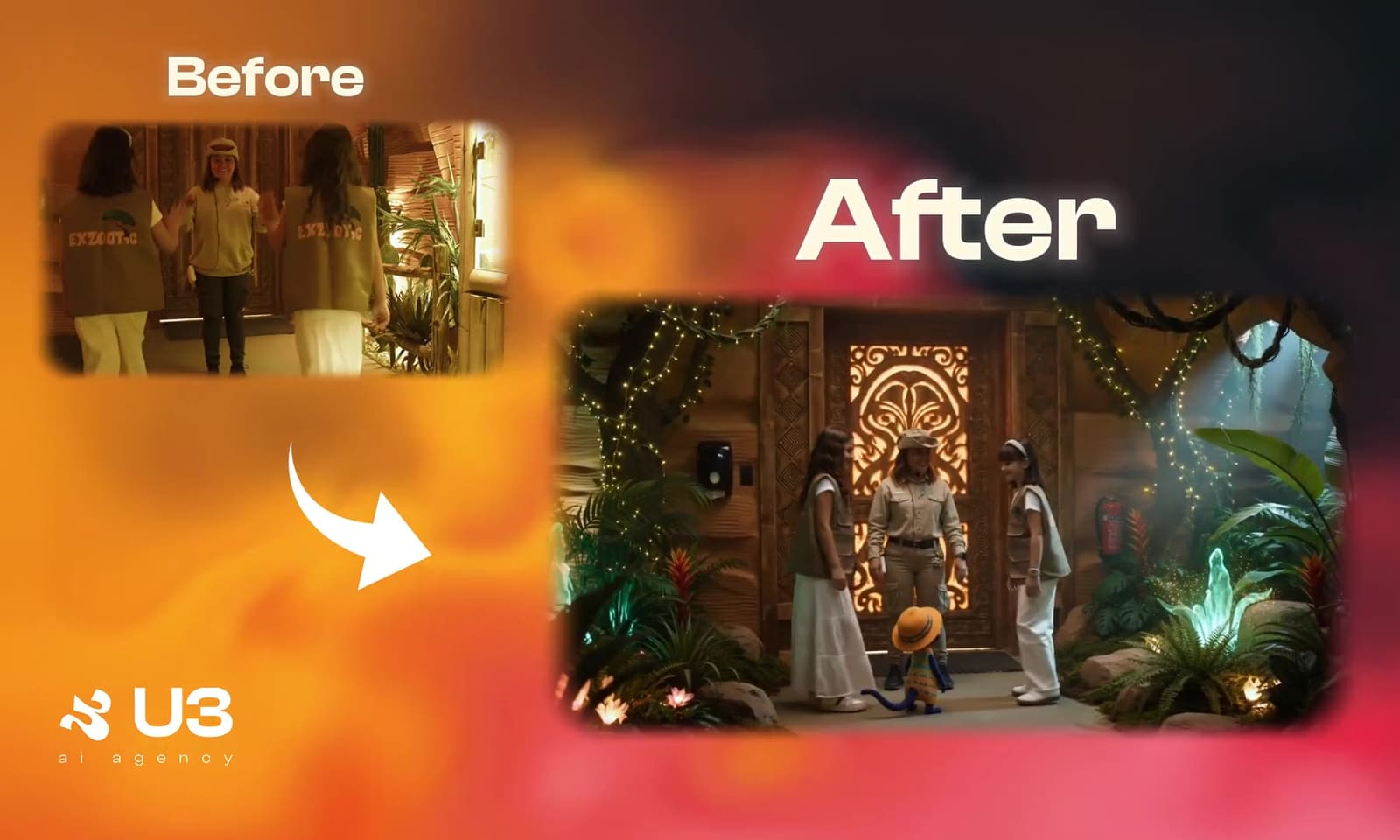
- The footage already exists: U3 also edits, composites, grades and dubs live-action footage. Exzootic, an indoor kids' jungle in Saudi Arabia, was filmed live and then finished with AI VFX on top of the real footage, shot by shot.
How to decide for your project
Ask three questions. Can the location be filmed safely and on time? Does the film need more than one language or many versions? Is a real person or a real place the point of the film? If the answer to the first is no, or to the second is yes, AI production is likely the stronger choice. If the answer to the third is yes, start from a camera and add AI where a camera cannot reach. That mix is what post-production at U3 is built for: footage for what is real, generated elements where the brief calls for them.
Either way, start with a short brief: what the film must do, who it is for, the languages and the deadline. U3 scopes each project from the brief, with no public rate card, and agrees the timeline at that stage. Brief an enterprise film, see AI commercials and campaigns, or read more about enterprise AI video.
Questions buyers ask
Is AI video production cheaper than a traditional shoot?
It removes the costs that come with the shoot, such as locations, permits, travel, day rates and reshoots, so the budget goes into direction, design, animation, sound and versions. Each project is still scoped and quoted from its own brief, with no public rate card.
Can real footage and AI be combined in one film?
Yes. Al Ahly Academy UAE's 2026/27 season-launch film combined real 4K academy footage with AI-generated cinematic shots in one 1:38 film.
Can an AI film show a real industrial site convincingly?
The thyssenkrupp Uhde safety film was produced without entering the plant: control rooms, refinery walkways and storage yards were generated and art-directed to match real oil and gas site conditions.
How fast is AI video production?
A focused ad lands in days, not months. The exact timeline depends on duration and complexity and is agreed at the brief stage.
Related work
- thyssenkrupp Uhde AI Safety Film in 3 Languages — Case study
- Al Ahly Academy UAE Season Film — Case study
- Exzootic: Real Footage to AI VFX, Before & After — Case study
Services
More insights
- How an AI video production runs: five approved stages, from brief to delivery — Every U3 production moves through five stages, and none starts until you approve the one before it. Here is what happens at each stage, what you sign off, and how payment, ownership and refunds work.
- AI dubbing for companies: one film in every language your teams work in — AI dubbing lets a company produce one film and deliver it in each language its people work in, every version lip-synced. Here is how U3 does it, with a published safety film as the example.
- AI product ads that sell: the real product, in four formats — An AI product ad works when the product on screen is the one that arrives in the box. Here is how U3 builds them, the four formats it uses, and what the published work in Qatar, Iraq, Saudi Arabia and Egypt shows.