Rights, consent and AI video: what brands should know
An AI film raises questions a camera shoot rarely does: whose face is this, whose voice, and who owns the result? These are the answers U3 writes into its policy and its contracts.
By Mohamed Yousry, founder · Published · 6 min read
AI video rights and consent: the short answer
In a film U3 makes for a client, a real person's likeness or voice is generated only with that person's documented consent, or their representative's, and only for the uses that consent covers. Public-figure work U3 publishes says what it is: commissioned by the artist or their team, a U3 original, or a fan-made tribute labelled as unofficial and never presented as official. The client owns the final film for the commercial use agreed in the project; those terms are written into the statement of work and transfer with the final payment, subject to the licences of any third-party assets or tools.
Everything here comes from U3's Rights & AI policy, which is written plainly and without claims U3 cannot stand behind. The sections below explain what each rule means for a brand writing a brief.
In client work, likeness and voice need documented consent
AI can make anyone appear to say anything, which is exactly why consent comes first. In a film U3 makes for a client, a real person's likeness or voice is generated only with documented consent, and the consent sets the limits: what a person agreed to for one use does not stretch to others.
The same rule applies when U3 dubs footage you already shot. The voice-over is produced in each language and lip-synced to the people on screen, but only with the consent of the people whose faces and voices appear. And when U3 scopes a feature film, the brief asks for the principal characters and any real-person likeness rights already secured.
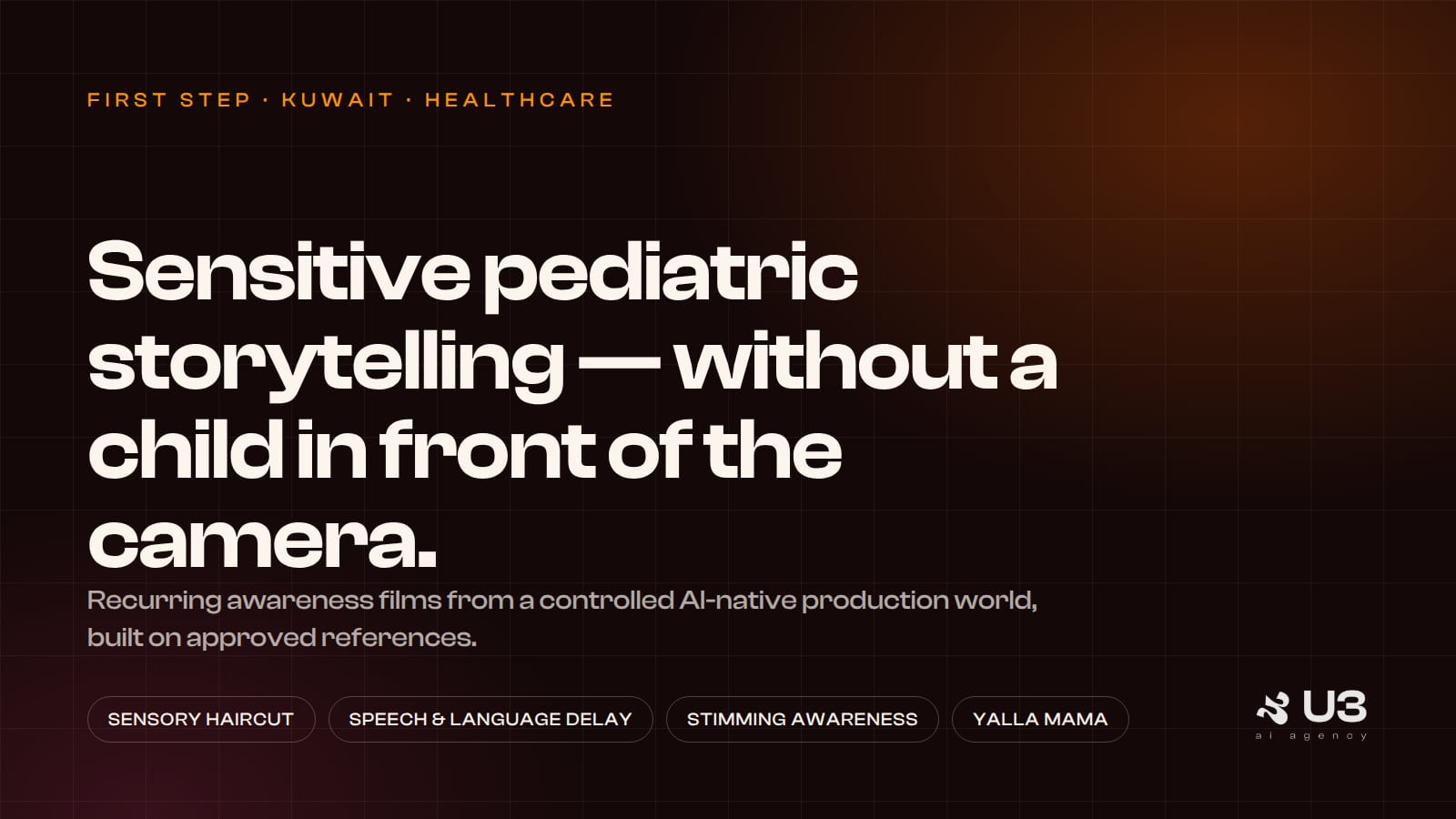
Sometimes the respectful answer is not to film a person at all. For First Step, an autism care centre in Kuwait, filming real children in therapy settings raised consent, dignity and consistency problems that would grow with every new film. U3 built a controlled production world from approved references, which stay private, so no child needed to be filmed.
Tributes are labelled, never passed off
U3 also makes work on its own initiative, and labels it. “Kifak Inta” is an unofficial, fan-made AI tribute that imagines Fairuz's song as a duet with Tamer Hosny. U3 made it without a commission, and the artists did not release it. It has no affiliation with Fairuz, Ziad Rahbani or Tamer Hosny; its end card credits the song to Fairuz and Ziad Rahbani, and the film's page carries the same label. Such tributes are labelled fan-made and never presented as official.
Artist-shared work is described exactly as it happened. U3 made AI visuals for two tracks from Tamer Hosny's 2026 album “Mesh Hatkarar” as U3 originals, and the artist subsequently published both on his own channels. Tamer Hosny is not a U3 client, and the case study says so.
For a brand the lesson is simple: if your idea involves a real, recognisable person, say in the brief whose consent you hold, because U3 will not put a real person's likeness in your film without it.
Who owns the final film, and when
You do, for the commercial use agreed in the project: paid media, broadcast, digital, internal, wherever the film needs to run. The statement of work defines the media, territories, duration and purposes the film may be used for, and what transfers to you on final payment.
Productions are paid 50% to start and 50% on delivery, so ownership moves with the second payment. Where a specific right matters to you, such as broadcast, paid media in a given territory or resale, U3 confirms it in the statement of work before production starts, not after the film is made.
Third-party tools and their licences
AI films are made with third-party models, platforms and tools, and the terms of a film are subject to the licences of any third-party assets, models or tools used in production. U3 says this openly: it does not offer blanket copyright promises that a third-party licence may not support.
On request, typically from enterprise procurement, U3 lists the models, platforms and tools used on a production, with their vendors and the licence terms that apply to the output. If your legal team needs that list, ask for it at the brief.
Your assets, confidentiality and AI disclosure
Logos, product photography, footage, voices and documents you share are used only to produce your project. They are not used to train models, are not shared with other clients, and are deleted on request after delivery. U3 signs your NDA before a brief is shared, or provides its own.
Nothing U3 produces for a client appears on its site, in its reels, on its social channels or in pitches to other clients unless the client approves it in writing: the film, the client's name and any frame of it, separately. Permission can be withdrawn, and the work comes down.
U3's films are produced with AI, and U3 says so. On request it provides a disclosure note describing what was generated, what was recorded and what was edited, and where a market or client requires an on-screen or in-description disclosure, it prepares the wording with you.
What to put in your brief
A few lines in the brief save a long email chain later. Questions from procurement or legal can go to info@u3-ai.com, and U3 answers in writing, usually within one working day; for how these terms sit inside a production, read how an AI video production runs. Before you send the project brief, note:
- Who appears on screen, and whose likeness or voice consent you already hold
- Where the film will run: the media, the territories and for how long
- Any specific right you need, such as broadcast, paid media in a territory or resale
- Whether you need an NDA, an AI disclosure note or a list of the tools used
Questions buyers ask
Who owns an AI video that U3 makes?
The client does, for the commercial use agreed in the project. Usage and ownership terms are written into the statement of work and transfer with the final payment, subject to the licences of any third-party assets or tools used in production.
Can U3 put a celebrity's face or voice in our ad?
Only with that person's, or their representative's, documented consent, and only for the uses the consent covers. Public-figure work U3 publishes says what it is: commissioned by the artist or their team, a U3 original, or a fan-made tribute labelled as unofficial.
Will our footage or logo be used to train AI models?
No. Assets you share are used only to produce your project, are not shared with other clients, and are deleted on request after delivery.
Will our film appear in U3's portfolio?
Only if you approve it in writing: the film, your name and any frame of it, each separately. Permission can be withdrawn, and the work comes down.
Does U3 disclose that a film was made with AI?
Yes. U3 says its films are produced with AI and, on request, provides a disclosure note on what was generated, recorded and edited, in the wording your market, platform or legal team needs.
Related work
- First Step Kuwait: Pediatric Health Content, No Kids Filmed — Case study
- “Kifak Inta” — an unofficial AI tribute to Fairuz — Film
- AI Music Visuals Shared by Tamer Hosny — Case study
Services
More insights
- AI dubbing for companies: one film in every language your teams work in — AI dubbing lets a company produce one film and deliver it in each language its people work in, every version lip-synced. Here is how U3 does it, with a published safety film as the example.
- AI product ads that sell: the real product, in four formats — An AI product ad works when the product on screen is the one that arrives in the box. Here is how U3 builds them, the four formats it uses, and what the published work in Qatar, Iraq, Saudi Arabia and Egypt shows.
- AI training and safety films for companies: multilingual, with no crew on site — Safety, training and internal-communications films can be produced with AI without sending a crew on site, and delivered in every language a company's teams work in. Here is how U3 makes them, with thyssenkrupp Uhde's published safety film as the example.